
Before we get into the knitty gritty (that’s the Flyers mascot, right?), it’s important that we cover NCAA hockey eligibility rules.
Because if you’re not eligible to play…the rest doesn’t matter that much.
In this piece, we’re going to cover it all for you.
In order to play ice hockey at the NCAA collegiate level, you not only need to meet athletic standards. You also need to meet the set NCAA eligibility rules + requirements.
For hockey players that plan to play at the DI or DII levels, you need to register through the NCAA Eligibility Center. A few of you older players/parents may know of this name as the NCAA Clearinghouse (it’s prior name).
This does not apply to players aiming to play D3 college hockey- but if you’re still giving it a shot to explore D1 even though you might play elsewhere, it’s good to check and see if your eligibility aligns by going through this.
Registering and going through this process with the Eligibility Center does the following:
•helps to ensure a player is on the right track to graduate high school (with the prerequisite coursework)
•GPA levels are met
•amateurism rule- this makes sure you haven’t compromised your amateur status (ex: playing professionally prior, etc)
If you’re a player/parent, reading the above info on the NCAA eligibility center and requirements might seem like a lot to do and can honestly feel a bit overwhelming.
Having helped numerous players through this process firsthand, we’re here to tell you that with the right help- it’s more straightforward than it seems.
The NCAA Eligibility Center is clear in their minimum requirements for coursework and GPA so that you can see what level you need to be at if this level of hockey is of potential interest.
A major NCAA rule change took place in that starting in 2025-2026, CHL (major junior) players from the OHL, QMJHL, and WHL can now play hockey at the NCAA level following major junior as long as they are not paid beyond necessary expenses.
For decades, you’d lose a year of NCAA eligibility just for staying with a major junior club at camp for a few days before the season and lose it altogether if you played there formally into a season.
In many cases, young players and their families were forced to decide at way too young an age on whether to go the NCAA or major junior route.
Not any longer.
This recent rule change that now allows high-end major junior players to stay NCAA eligible (if they maintain amateur status) has made it even more competitive to earn NCAA athletic scholarships.
This rule change does not apply to Division III ice hockey though which is important to mention.
Ice hockey is unique in that for most collegiate sports (football, baseball), athletes will go straight from high school to college at 18. In the hockey world, the most common path for the majority of ice hockey players is to first play anywhere from 1-2 years of junior hockey after high school before entering college hockey as a freshman.
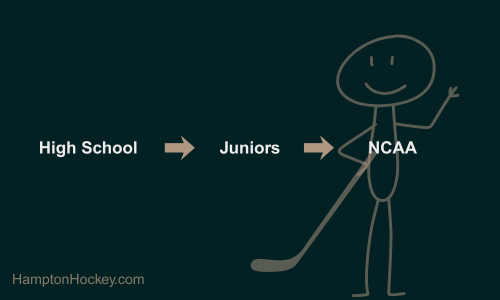
This naturally stretches out the recruiting timeline out several years.
As we noted earlier, a subset of elite players may commit to NCAA programs early, but for many more players aiming to play college hockey- this system of junior hockey between high school + college strongly incentivizes coaches to scout prospective players later as they get a little older and face stronger competition (during juniors) before deciding on recruiting them, inviting them for campus visits, and even giving scholarship offers.
Many quality D3 hockey programs will recruit players at these stages too. Especially for on the fence D1 players who may not have scholarship offers- since more players may be open to playing high-end D3 at the later stages based on their overall on and off ice preferences (maybe more of an integral leadership role on a D3 team, school has the right degree, academic scholarships, and other draws).
We mention the above as it’s important for players to know that players get recruited at all ages across the spectrum from 15-20. So if you’re towards the later part of the above, you’re not alone.
For prospective players (and families) that want to look into what initial step they need to take regarding the Eligibility Center that we mentioned above, you can visit the NCAA's official website. Beyond this step (of many), you can send us a message and we’d be happy to review your situation.
In our next piece on NCAA Hockey Scholarships, we’ll break down the various scholarship opportunities and cover best approaches that you can take in order to increase chances to receive one (as well as how to get interest from NCAA teams).