
For players (and families), thinking about the whole college hockey recruiting process, earning scholarship opportunities, initiating communication, campus visits, and more can seem like a lot to chew.
There’s quite a bit of nuance around recruiting timelines for when it can begin, periods of time where coaches can (and can’t) talk with players, unofficial vs official visits, and knowledge around how to get scouted.
Our aim here in this article is to help demystify some of this info for you…
We'll start with the first date to keep in mind.
Prospective high school hockey players are only allowed to begin correspondence (recruiting messages/calls) with college coaches after January 1st of their sophomore grade year (Grade 10).
To paint a real example, if a player (or their family) tries to email or call an NCAA DI hockey coach before the player meets this age, the coach cannot respond to you (no matter how good you are) with anything other than a polite general reply. Once you hit the January 1 date of sophomore year, then conversation can commence.
From this point on, players and coaches can communicate both ways.
Note: a number of players we’ve helped play at the top level of college hockey are late bloomers...so if you’re older and reading this thinking “geez, I’m past that age already,” don’t worry. This early-timeline info is helpful context, but there’s much more below that applies to you.
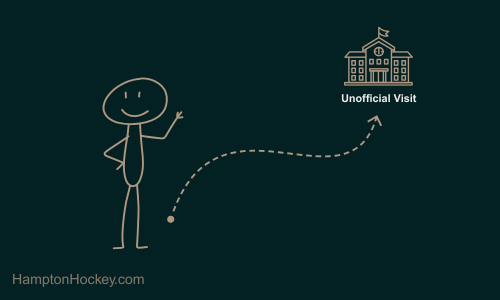
At this same time (January 1 of a player's sophomore year), players can also take part in unofficial visits to schools.
The key here being “unofficial.”
Though these early activities allow players/coaches to put plans in motion, there’s another important date to keep in mind…
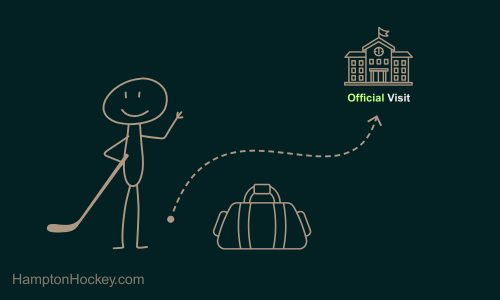
Beginning August 1 before a player enters junior year (Grade 11), you are now allowed to do the following:
•Official school visits
•Receive or give verbal offers
•Additional off-campus contact (beyond the more restrictive early window)
It’s at this point (and after) where the recruiting process intensifies.
We like that the NCAA has the August 1st rule of a player's junior year because it importantly gives players (and their families) a bit more room and time to see what happens. At 14 or even 15…players are still so young and a lot can change.
Though the recruiting process opens up more beginning on August 1st of a players junior year, there’s still a few strict rules for coaches/players to follow.
For example, NCAA D1 hockey coaching staffs only have seven recruiting opportunities in total per each prospect and of the seven, only three can be in-person off campus contacts
The reason this rule is in place is to lessen the intensity and pressure put on young players as well as the travel component since most players need to travel a decent distance to the school.
Many top-caliber recruits will eventually sign a National Letter of Intent (NLI) late in their senior year (or later) if they receive an athletic scholarship.
Signing the NLI formalizes their commitment to the school’s program (e.g., Boston University).
There are a few remaining NCAA recruiting periods worth understanding.
The name is as it states and is when coaches may have contact or face-to-face interactions with recruits (either on or off campus). Full recruiting activity is permitted from scouting players games to visiting them.
This period in the college hockey recruiting calendar is more restrictive. During these quiet periods, coaches generally cannot leave campus to recruit, scout, or meet a player at the player’s games (or home).
They can host the player on the college campus or talk by phone with them though.

This period is the most restrictive in the college hockey recruiting calendar- as no in-person contact is allowed at all. NCAA Coaches cannot host recruits on visits or have face-to-face talks anywhere, although phone calls and electronic communication may still occur.
In ice hockey at the NCAA level, these dead periods are used very sparingly. We just mention them so you’re aware.
As one example, the couple of days near the early signing date in November (when recruits often sign hockey NLIs). Another dead period comes during the NCAA Frozen Four championship at the end of college seasons.
Coaches involved in the championship tournament shouldn’t be recruiting during this time, so the period is placed here in fairness to them.
For exact dates per each of these, the NCAA publishes these on their NCAA Recruiting Calendar.
Once a hockey player hits their senior year and beyond (as most players reading this will play another season or 2 of juniors past high school), the rules and restrictions around all of the above ease up naturally.
For late bloomers as we mentioned above who might break out and start elevating the level of their game in say a final 1-2 years of junior (or prep), you’ll go through a similar recruiting process.
It’s just happening later for you based on your development path and is not as early. We’ve helped players in all sorts of situations so if you’re reading this, we’ve likely helped players in a similar spot to you.
What's next?
Now that you have a bit deeper understanding of the nuances of the recruiting process and rules, we now need to turn our attention to the most important topic at hand.
And that is, what steps do you need to take to now get recruited and scouted to play NCAA hockey.