
So how do you get recruited for college hockey and get team(s) interested in you?
This is the all important question that many players (and families) have.
We spent the entire last piece of this guide on the Recruiting Process itself in terms of NCAA eligibility rules, when players/coaches can and can’t communicate at various stages, and so on.
Here in this piece, our aim is to help give you the right info and strategies you need so that you can start taking action to actually get recruited by college hockey teams.
The process of being recruited for any NCAA ice hockey program can be lengthy and seem complex.
For many players, garnering interest (and potentially earning an NCAA scholarship) from college hockey teams is often as much about preparation + planning as it is about raw hockey talent.
Sure- for a very small percentage of elite players, they might be able to make the jump and get offers with raw talent alone, but in our experience, there’s many more players who don’t fall in this category where everything happens organically.
To play at the NCAA level at any level, you need to be at a certain level (or have the potential to), but there are many things you can do in the process that can greatly increase your chances of playing at the top collegiate level, attracting scholarship offers, and more.
These are all variables that are in your control. And what we’ll be focusing on below.
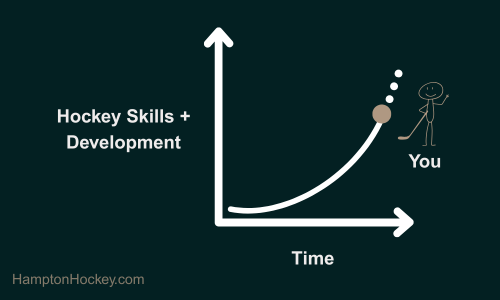
This top one off the bat might seem obvious, but there’s more nuance to it. We just mentioned above that a player needs to be at a certain level to play college puck today with how competitive the level is.
One of the primary ways to do that is to put yourself in a position to develop your skills in the right setting during your formative playing years (as a teenager)
You can do this via three distinct pillars which are:
1) playing at the best level possible and seek out the best setting/competition for your situation (who you play for)
2) consistently training with intention on + off the ice (combo of training, being coached + solo or small group skill work)
3) packaging + exposure (presenting yourself professional + standing out)
We’ll cover each of these below in detail.
If it’s possible to, you want to try to play at the highest level you can (or close to).
For some, this will be AAA, prep, AA, elite high school, or juniors depending on where you live, financial situation, and what stage you’re at with hockey today.
Of course you want to play at the highest level, but this is not the only metric you want to look at.
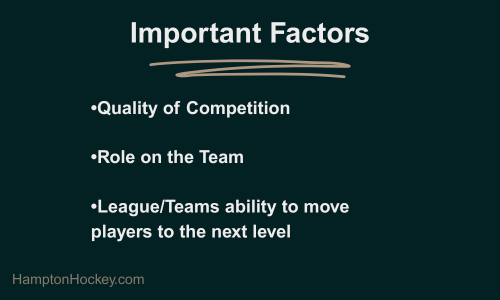
It’s important to consider the quality of competition, what your potential role will be on the team, and what the overall league (and team's) development is like for their players in terms of where they play next beyond that league.
For example, being a middle of the pack player who plays well in an elite junior league (USHL, NAHL) may gain you more exposure than throwing up 30-40 goals in a lower junior league due to the sheer exposure the elite junior tiers give you.
There are other times where the opposite is true. If a player/goalie is fighting to make the game night roster in a top junior league all season, it might make more sense for them to play in a slightly lower tier where they’ll be more of an integral player for them. They’ll not only be able to benefit from more ice time and game pace development, but their resume will look a bit better (especially if they weren’t playing at all on the higher team).
It’s all situational.
We gave two quick examples above, but there’s countless situations like this, including yours.
If you’re already with a team now that can be a stepping stone to college hockey, great.
If not, the easiest way to think about where to potentially play next is to balance playing at the highest level you (or your player) can while also trying to ensure growth and strong results on ice as best as can (meaning you have opportunity on ice to do so).
It’s helpful to look at any AAA, prep, or junior team or league and see how many players from there go on to play college hockey. Some leagues like the USHL make it crystal clear how high quality their reputation is in terms of developing NCAA players, but many other leagues do as well.
For lower to middle tier teams and leagues, you may need to ask a member of the coaching staff a question like, “We’ve been talking with a few teams and one thing we’re trying to understand is how each program helps players with college exposure and progression to the next level. What’s that process like for your team? How many players have moved on to NCAA in recent years?”
By asking this question (if needed), this should help give you a bit better sense.
Following the importance of aiming to play at the next level, we now need to cover the importance of training and development.
Consistent Training & Development with intention on + off the ice
Every player may not have the same access or hockey training resources at their disposal, but how intentionally you train (and develop your game) on and off the ice are two areas that are very strongly in your control.
If you have access to quality skills coach on the ice or in the gym (via trainers), take full advantage of it and don’t take it for granted.
Access to ice time or a gym may vary quite a bit depending on the time of year as well as your personal situation (finances, where you live, etc), but the more you can refine your game overall, the better.
We know not all players have the same luxury of training facilities, open ice time, etc so we’ll bold the following.
Creativity and intrinsic motivation in one's hockey training can be a budding player's best friend in terms of elevating their game.
What do we mean by this?
If there’s no hockey skills coaching sessions available to you but a local ice rink has open ice time, take full advantage of that. Make a hockey training plan before you hop on the ice and follow it.
If there’s no ice time, can you stick handle in your driveway? rip shots outside? do visualization exercises?
If you don’t have an ice hockey trainer, there’s a plethora of great resources online. Start incorporating those wisely into your routine.
If you don’t have access to a gym with the right equipment, do you have some open floor space (at home), a park, or a hill nearby to exercise at?
Get creative and work on complimentary skills that will translate to the ice.
We’ve found over the years that whether a player is a best in class U-17 national player or a late blooming 19 year old player who’s just playing their first year of juniors, the ones who often keep elevating their games the most and make it to the highest levels are the ones who diligently work on their game day in and day out over a long period of time.
The consistent act of you working on your game will pay dividends.
Pair this with our recommendation above to play/train in the best setting as possible with our third pillar below (which is Packaging, Exposure, and Advisement) and you’ll be way ahead of the far majority of competing prospective players.
So you’re playing at the best level you can and training your tail off on and off the ice.
Great. That’s expected!
The work you’re putting in is hopefully translating to your game on the ice and coaches are starting to notice. For many players, this effort alone often doesn't earn you interest to in turn be recruited from top college hockey teams (let alone earn an NCAA hockey scholarship).
As you know, stats on paper don’t tell the whole story (or potential) of a player.
If you want to play NCAA hockey, you need to be able to showcase to college teams all around why you’re a viable and intriguing candidate that they should strongly consider.
You can do this exceptionally well in a number of ways which we’ll cover:
•Hockey Resume + Stats
•Professional Packaging
•Exposure + Advisement
Hockey Resume + Stats (Packaging)
An important part of your story that most every team(s) will care about is your hard stats on paper.
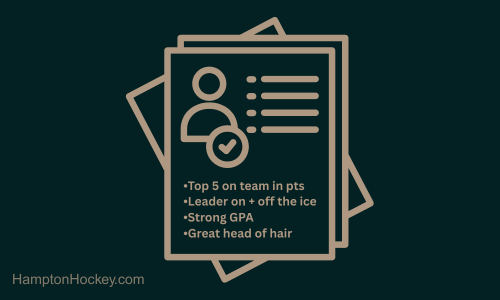
Where have you played? How did you play there? Does this give us confidence you can play well at the next level? Among many other questions.
As we just touched on above, stats don’t tell the whole story- but they are an important pillar that factually shows your chops.
Note: for younger players, you don’t always have the longest playing history based on league stats. With this, teams may rely more on seeing a player on ice, a reference, or seeing video clips (we’ll cover this below) in order to analyze their play.
Since we have helped work with many players over numerous seasons ranging from elite U16-18 players to underdog overage junior players just coming into their stride, we know how to frame a players ability so that you can best compel teams to give you the time of day.
Without this, your chances are severely limited based on how competitive it can be.
You may not be able to change where you have (or haven’t played) the past year or make your stats from last season 2x better, but what you can do is control the other areas around how your skill set is packaged and viewed externally.
You do this by having:
•dialed and professional messaging and communication (that tells your hockey story)
•complimentary video assets (both game highlights + training clips)
When we work with a player, one of the first areas we focus on in our process is in professionally dialing down their story and messaging.
Some players resumes can do a lot of the talking for them (say you’ve been ripping it up in a top junior league). For most, your story and attributes as a player still need to be enhanced a lot more beyond stats to garner the right college attention.
For instance, if you’re one of the best shut down defenseman in your league but barely have any points, you need to be able to convey that to prospective teams. Because unless they see you at a tournament or are virtually scouting your game(s), they may not know you exist otherwise. If you’re a goalie getting peppered all night but you’re fighting for a .880 or a forward not getting enough ice time to rip it up, the same goes for you.
By having high quality video clips showcasing your highlights, full shifts, and so on, you’re best able to share this with them.
Complimentary Video Assets

Having quality video footage that you can share easily with coaches can help.
Various game streaming platforms today can provide coaches with access they need to see clips overall, but coaching staffs don’t nearly have the bandwidth to manually vet thousands of players across all the leagues to that deep of an extent.
By you having quality video on hand and giving coaching staffs the clips they want to see of you, you make their job easier. Which in turn makes it easier for them to learn about you as a prospect.
For players with less game highlights (let’s say you’re coming off an injury), we aim to focus video a bit more around high-tempo hockey training clips in order to show prospective teams what your game and movement on the ice is like presently.
Most college hockey coaches will prefer to see game clips or shifts (if available), but we’ve had many instances where a college team ultimately offered a player an NCAA scholarship in part because of the exceptional video footage we helped the player craft which showed them the players fit.
We’ve found the combo of good game highlights plus game speed training clips to compliment it works best.
When you film training footage and aim to share that with any scouts/teams, it has to be high quality and full tempo.
Filming a few reps of you on the ice, chin strap off, and going through the motions shooting statically from the hash marks on a rec league will never cut it.
When we have our players create hockey training footage, we give you specific criteria in how to easily film it, what types of drills to do (based on position), and how to run through it. This makes a huge difference and in turn, coaches take you seriously as a prospect.
For each player we work with, we personalize this to ensure clubs see you in the best way possible based on your circumstance and it’s worked well.
Exposure and Hockey Advisement

Once you have all of the above from your packaging (resume/story) to your complimentary assets (video, custom profile, references), you now need to properly pair it with the right exposure.
Without doing so, prospective NCAA hockey teams may never be able to learn about you.
If as you're reading this, you only have a portion of the steps done above so far (maybe you still need to compile new video clips), that's normal. Having helped players through this process over the years, we know how to lay it all out for players so it's easy for you and in turn you have all the right components dialed down to attract college coaches to you.
We hope that the information in our guide above has helped give you some insights into what steps you need to take. If you are a prospective player that's motivated to play at the next level, but you could use seasoned advisement to maximize your opportunity to play NCAA hockey, send our team a message and our team will happily look over your situation to see if we believe we can help.